


Doubts about the accuracy of the claim rise simply because of its author. A company like Booking.com can only profit from positive news about the tourism sector. By focusing on Spain in the post and saying there “the majority say traveller numbers are about right or not enough”, they say there’s close to no issue at hand. Even though in major Spanish cities, locals have been targeting international tourists in protests 2 summers in a row now. The Booking.com media relations team chose not to reply to a request for comment.
Native advertising on Statista
The data visualisation in the X post is provided by Statista, a generally reliable data platform trusted by international journalists. However, the related post on statista.com is sponsored by Booking.com. This is an example of native advertising, where Statista creates content in partnership with a company to monetize in a way that's less disruptive than traditional advertising. Thomas Hinton, Statista data journalist commented that posts sponsored by Booking.com are part of the Accommodation Barometer series created because “Booking.com identified a gap in data that is applied specifically to the accommodation sector and through Statista they are able to make data on this industry more accessible.” Since the content is clearly labelled as “sponsored by”, it is legally still correct, but it does make this specific post less neutral.

The post on statista.com remains fairly neutral or even rather positive in describing the statistics presented. Just like the X post by Booking.com, it doesn’t further address the issues that exist in the tourism industry.
Contradicting voices
That’s a different story when looking at the primary source. The data was originally collected by YouGov in a EuroTrack survey of August 2024. YouGov is a “global research data and analytics group”. On their own page, they used the same data as Booking and Statista for a write up published on September 13, 2024, which frames the data differently. Already in the lead, they write: “People in Spain are particularly likely to feel there are too many tourists in their local area, and take a negative view of the holiday lets sector”.
When asked to comment on the difference in Framing, Christopher Davies, PR manager at YouGov, said: “We are neutral on all topics of public debate, and in our own published work strive to present public opinion as it is, without bias. As far as I am aware Booking did not make us aware of this post and would be under no obligation to do so. Since the numbers are correct we have no issue with this use of the data.”
In comparing the Booking post on X and the YouGov article, a reason for the difference in framing shows. Both address the 32% of Spaniards who feel there’s not enough international tourists, but the YouGov article goes deeper and covers all 25 questions asked in in the publicly available survey, whereas Booking and Statista only refer to one.
Questions also arise because the data may be outdated. As mentioned before, the data got collected by YouGov in August 2024, almost a year before Statista and Booking picked it up. YouGov collected the data independently. Chris Davies remembers YouGov chose the topic in 2024 “because anti-tourism protests were in the news at the time and we thought it would be interesting to explore the issue.”
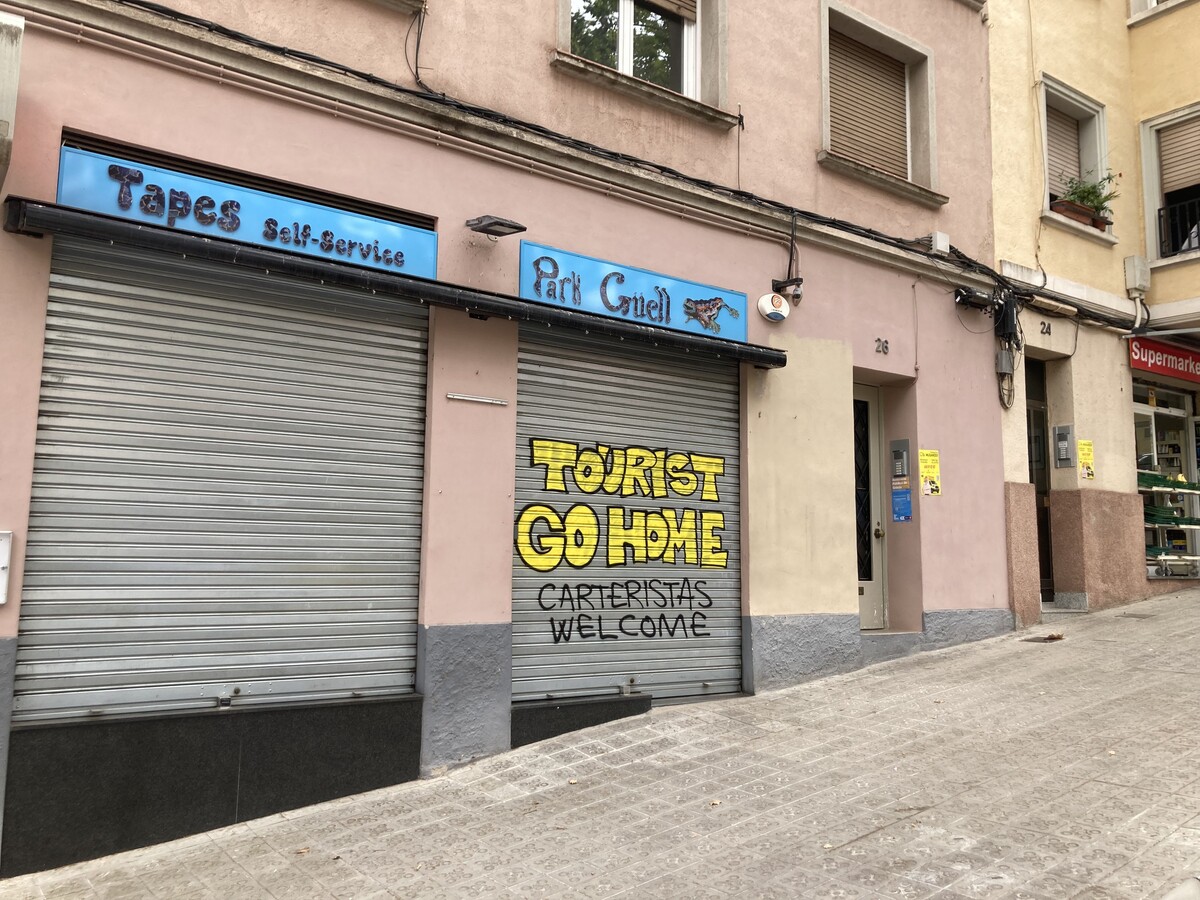
Spain protests against tourism
These protests continued in 2025 and are a reason to doubt the claim made by Booking. To the 32% of Spaniards who indicated in the survey that there’s too many tourists, the problem is big enough to turn to the streets. Their biggest protest argumentation is the housing crisis.
Dr. Alvaro Ardura Urquiaga, professor of urban planning at the Polytechnic University of Madrid, explains that “the threat of changing a dwelling to short term rentals directly increases the rent of the current inhabilitants to renovate the contract.”
Brian Rosa, urban geographer affiliated with the Autonomous University of Barcelona, adds that short-term rentals “are considerably more profitable than long-term leases.” and that “the financialization of rental housing is a big issue, as is the amount of second homes, vacation and seasonal lets (aimed at expats and digital nomads) on the market. All of this is related to treating housing as a tradeable asset class rather than a right.”
Rosa also confirms that “The housing crisis is definitely worst in major cities that also have large tourist economies: so, Barcelona, Madrid, Valencia, Malaga, Sevilla, Alicante, and the major cities of the Canary and Balearic Islands.”
These protests have already had some effect. Since the 1st of July 2025, all short-term tourist rentals offered on online booking sites need to be registered in the ‘holiday home registration’. This way, the Spanish government has a better overview of the short-term rental offer. On top of that, the city of Barcelona announced they will phase out all short-term rentals to tourists by November 2028.
Local communities generally do remain supportive
However, Booking.com doesn’t make an entirely wrong claim since they say the local communities remain “broadly” supportive, not completely. And they are likely referring to the whole of Spain and the whole of Europe, for which this statement would be a correct interpretation. The numbers collected by YouGov and visualised by Statista indeed indicate that not all Europeans and not all Spaniards are against tourism.
After all, people can remain supportive of tourism since it does still bring many economic benefits. Tourism contributes for 207.8 billion euros to the Spanish GDP, that’s 13% of the total GDP.
Conclusion
The claim is mostly true since in the end, the majority of Spaniards is indeed still pro tourism, saying there’s enough or can be even more international visitors. It is, however, important to look at what’s behind these numbers and realise that there is a reason that more Spaniards than, say, Germans and Swedes feel more negatively towards tourists.