

Why is fertiliser a critical input for agriculture and food security?
Fertiliser crucially influences European agriculture and food security. According to Eurostat, the European Union's official statistics agency, approximately 9.3 million tonnes of mineral fertiliser were consumed in the European Union in 2023. Fertiliser is used in agriculture to enhance food production. Its main aim is to feed plants to ensure better growth and stronger, healthier yields.
As stated by Łukasz Pasterski, Director of Communications and Public Affairs at Fertilizers Europe, "Farmers recognise fertilisers as indispensable to European food and feed production and a cornerstone of Europe’s food security." Therefore, the European farming industry remains highly dependent on fertiliser production and trade.
How has the disruption of the Strait of Hormuz affected fertiliser trade flows?
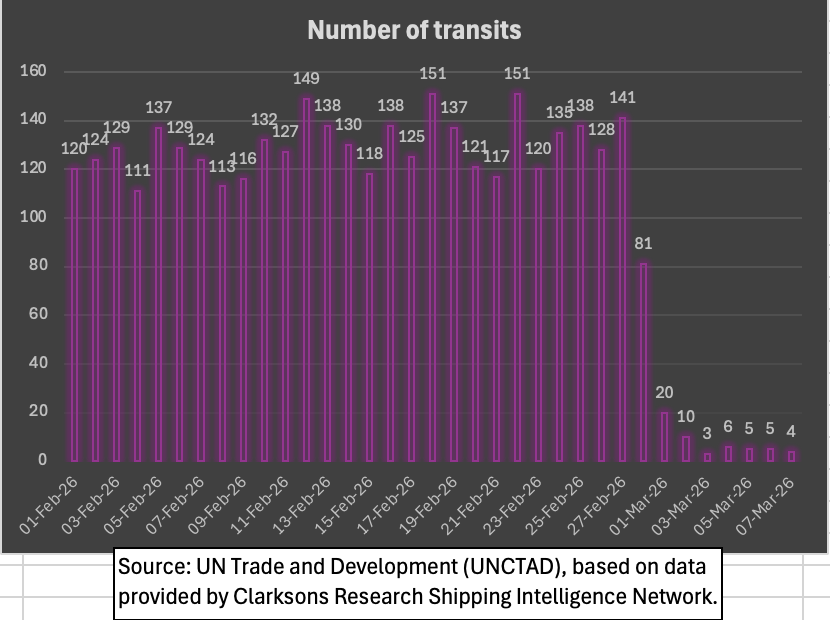
The Strait of Hormuz, located in the Middle East, remains one of the world's main trade routes for oil and other natural resources. Due to the Iranian conflict, the passage has stayed closed since late February. United Nations Conference of Trade and Development (UNCTAD) reports that the total number of ship transits through the Strait of Hormuz has dropped from 141 on the 27th of February to only 4 on March 7th. Leading to crucial disturbances in global trade flows.
As mentioned in a document published by the European Commission Directorate General for Trade and Economic Security, the European Union imported 59 million euros worth of raw materials from Iran in 2024. Most of which passed through the Strait of Hormuz. Thus, the closure of the vital waterway leads to a decrease in imports of pivotal materials used in fertiliser production in the European Union.
How reliant is the European Union on imports from Iran and the Gulf Region?
Despite the conflict triggering major disruptions to European Union imports, the European market has a low reliance on strictly Iranian imports. According to the European Commission, in 2024, trade with Iran accounted for 0.1% of the European Union's total imports. This suggests that the conflict has limited impact on the European Union in this aspect.
Yet, as Eurostat stated, the European Union's trade with the entire Gulf Region amounted to 62.3 billion euros in the same year. With over 80% of this number being led by raw materials import. As the war is now unsettling global trade routes and blocking vital passageways, the European fertiliser market remains unstable. As mentioned by Fertilizers Europe, in a statement published on March 11th, "Disruptions anywhere in the system can quickly have knock-off effects on the input costs." Leaving many in fear of growing food costs and inflation in Europe.
How is the fertiliser crisis contributing to inflation in the European Union?
As energy prices rise, production costs do too. Leaving farmers with decreased crop yields and consumers with higher food prices. This economic phenomenon, often referred to as the "scissors effect", is a major cause of food inflation. Eurostat claims that the European Union's inflation rose to 2.5% in March 2026, up from 1.9% in February of the same year. This increase has been significant. The sharpest since February 2023. Many attribute this growth primarily to the Iranian conflict. According to agricultural economist Professor Alan Matthews of Trinity College Dublin, "With the loss of gas supply from Qatar in particular, one can imagine that the competitive position of EU fertiliser manufacturing could worsen again." Gas remains the main raw material for European ammonia production and thus for nitrogenous fertilisers. Therefore, its limited supply will lead to higher production costs.
Professor Matthews also recognises the importance of raw material imports for European gas prices. "The indirect effect of reduced natural gas imports from the blockaded Gulf countries has also pushed up natural gas prices in the European Union", he states. This lack of gas trade leaves many European countries stretched for supplies, driving inflation and costs higher. Ultimately causing many European consumers to feel anxious about what the future may hold.
What would a prolonged war mean for the European fertiliser market?
If the Iranian conflict continues, global trade flows are expected to remain unsettled. This would keep fertiliser production costs high, putting extended pressure on European farmers. According to Iranian state media, Iran is considering charging tolls to pass through the Strait of Hormuz. However, this proposal would be seen as conflicting with international law, as set out in the United Nations Convention on the Law of the Sea (UNCLOS). This would likely cause continuous disruption to already fragile trade routes, potentially damaging global markets and intensifying European agricultural issues.
Various agricultural organisations, such as Fertilizers Europe, are calling for increased support to European farmers. The association states that "EU institutions should consider reinforcing aid and assistance to European farmers, while supporting the resilience of Europe's fertiliser industry", in a March statement. A lack of action could keep inflation above expectations, damaging the wallets of European consumers. Additionally, the fertiliser crisis exposes the European Union as vulnerable to external surprises, highlighting concerns about its long-term vision for agricultural stability.